
Loxone or KNX: Which is right for your house?


Are you planning a smart home and wondering whether Loxone or KNX is the right system for you? This comparison will help you decide.
First off, let me clarify who's writing this: Luttinger Technologie is a Loxone Platinum Partner, with a showroom and company headquarters at Viessmannstraße 2, 4641 Steinhaus near Wels. We work with Loxone daily, and that influences our perspective. Therefore, this article will remain objective. We'll explain both systems, list our sources at the end, and openly discuss when KNX might be the better choice.
Contents: What Loxone is · What KNX is · The differences at a glance · In new buildings · In existing buildings · Combining both · When KNX is a better fit · Decision-making aid in five questions · Costs · Process at Luttinger · Frequently asked questions · Sources
What is Loxone?
Loxone is a system from a single manufacturer. Hardware and software come from one source and are perfectly coordinated. The central control unit is the Miniserver. According to Loxone, up to 30 extensions can be connected to it via the Link interface, providing additional inputs, outputs, or interfaces. There are also two ways to connect devices within the house:
Tree is Loxone's cabling technology. Devices are connected to a shared Tree cable that carries both data and power. According to Loxone, up to 50 devices and a total cable length of up to 500 meters are possible per Tree branch.
Air is Loxone's wireless technology. According to Loxone, communication is encrypted, and there are battery-powered devices for easy retrofitting as well as devices with a fixed power supply.
Programming is done using the Loxone Config software. Loxone Config is free, there are no license fees, and it works with more than 150 ready-made building blocks that require no traditional programming knowledge. An auto-configuration creates a basic configuration for the most important functions.
What is KNX?
KNX is not a product of a single manufacturer, but an international standard. According to the KNX Association, it does not belong to any one brand. Devices from various manufacturers are certified and are designed to work together. The KNX Association lists over 8,000 certified products from more than 500 manufacturers.
KNX operates as a bus system. All devices exchange data via a shared network, and the intelligence resides decentrally within the devices themselves. Each device has its own microprocessor; a central control unit is not required. According to the KNX Association, if one device fails, the others continue to function; only the dependent functions are affected.
KNX is configured using ETS, a manufacturer-independent software from the KNX Association. A trial version is available; a license is required for regular use. Professionals can become certified KNX partners by completing a basic course and passing an exam. Certified partners are listed in the KNX Partner Directory.
According to the KNX Association, there are several ways to implement the bus: the classic bus cable (twisted pair), powerline, radio (KNX RF), and IP. In new buildings, it is common to install the bus using a single cable. In existing buildings, new cabling is not always possible; in such cases, radio is available.
The differences at a glance
The graphic shows the seven most important criteria at a glance. The same overview is presented below in table form.
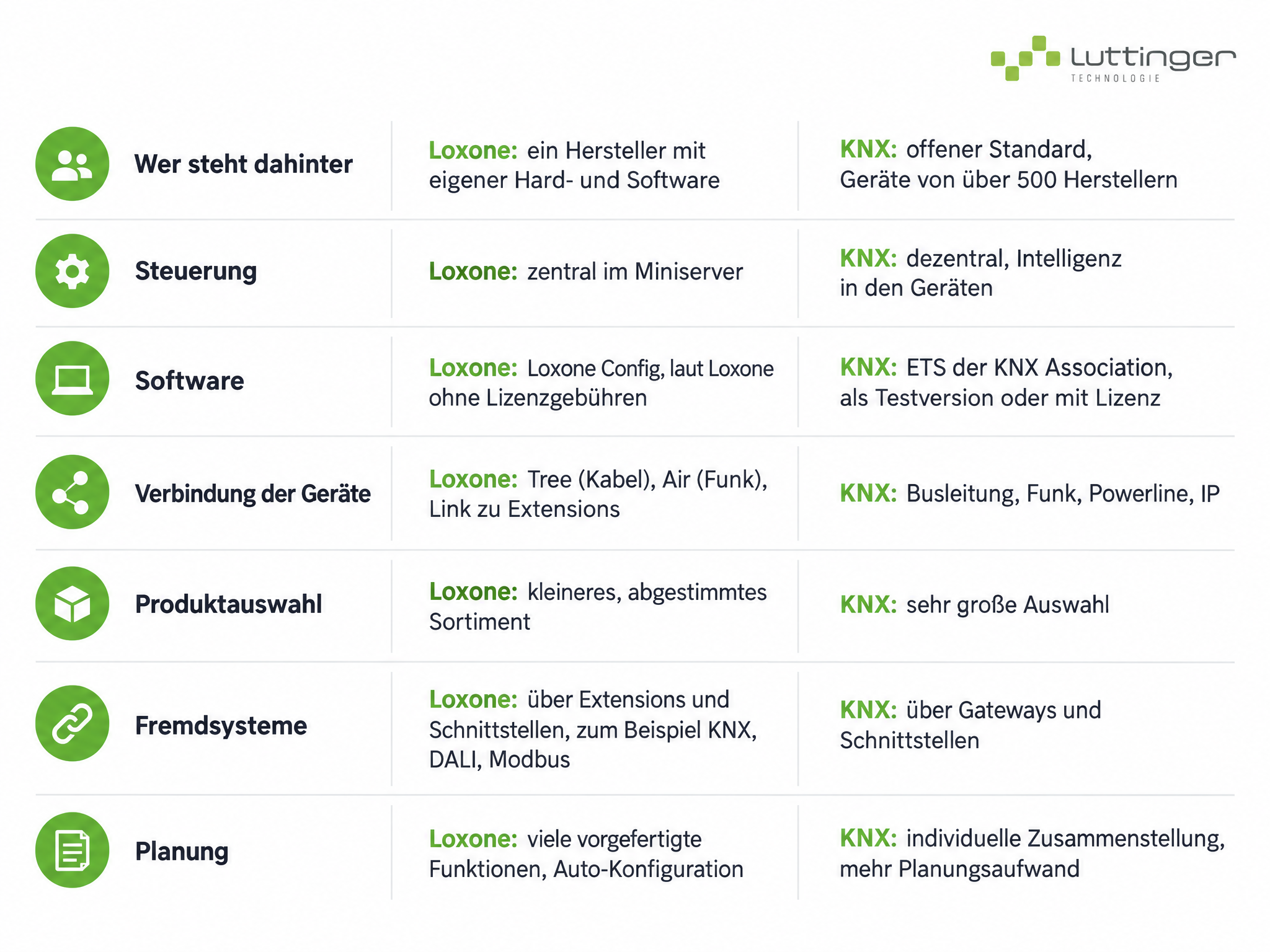
criterion | Loxone | KNX |
Who is behind this? | a manufacturer with its own hardware and software | open standard, devices from over 500 manufacturers |
steering | centrally located in the miniserver | decentralized, intelligence in the devices |
software | Loxone Config, without license fees | ETS from the KNX Association, as a trial version or with a license |
Connecting the devices | Tree (wired), Air (wireless), Link to Extensions | Bus line, radio, powerline, IP |
Product selection | smaller, coordinated product range | very large selection |
External systems | via extensions and interfaces, for example KNX, DALI, Modbus | via gateways and interfaces |
planning | many pre-configured functions, auto-configuration | Individual configuration, more planning effort |
You'll notice three differences most in everyday life.
Centralized or decentralized. In Loxone, the Miniserver is the control center. This simplifies many functions, but it also means that the Miniserver is the central control unit. A KNX specialist company points out that a Miniserver failure poses a risk of a complete system failure, and that precautions can be taken to mitigate the consequences. Loxone itself considers a Miniserver failure extremely unlikely, as it has no moving parts, and states that the failure of individual sensors or actuators does not affect the rest of the system. With KNX, if a device fails, the rest of the system continues to operate; however, there is no central point that links everything together.
Selection or coordination. KNX gives you free choice of manufacturers, appearance, and functions. According to Loxone and KNX specialists, the price for this is increased coordination effort, because a planner has to build a comprehensive concept from many components. With Loxone, you get a coordinated product range. However, according to KNX specialists, this can mean that some products or interfaces may not meet every requirement.
Open or from a single source. If manufacturer independence is important to you, that speaks in favor of KNX. If a single point of contact for both hardware and software is important to you, that speaks in favor of Loxone. According to Loxone, hardware and software from a single source simplify support and maintenance. Both sides are right; it comes down to what's more important to you.
In new buildings: what speaks for which system
In new construction, the decision is made early on because the wiring, conduits, and distribution boards are designed accordingly. According to the KNX Association, it's standard practice in new buildings to install the KNX bus using a single cable. Loxone uses the Tree cable system. Loxone recommends one Tree cable per room from the distribution board, branching out to the individual devices within the room.
Loxone is a good choice for new builds if you're looking for a complete package with many ready-made functions, if a single point of contact for the system is important to you, and if you want to use many features right out of the box. KNX is a good choice if you want maximum freedom in device selection or if your planner and electrician are KNX partners and are developing a customized concept.
Are you currently building? You should read our new construction guide . It shows you what to decide during the planning phase. If you're still at the beginning and unsure which system to choose, now is a good time to talk to us before any wiring is laid. If you've already planned for KNX and are now considering Loxone, it's best to get in touch while the installation is still minimal. We can then discuss the possibilities on a case-by-case basis.
Existing infrastructure: wireless instead of new cables
In existing buildings, the question often arises: Do walls need to be opened up? Both systems offer a wireless solution to this question.
Loxone calls it Air. According to Loxone, there are battery-powered Air devices designed for easy retrofitting. The range depends heavily on the building. Loxone cites values ranging from under 10 meters under challenging conditions to up to 250 meters with an ideal line of sight and external antennas. Materials and sources of interference weaken the signal, and Air devices with a fixed power supply can act as repeaters, relaying signals. What this means for your home can only be reliably assessed on-site.
KNX also supports wireless technology (KNX RF, in the 868 MHz band). The KNX Association describes wireless as a way to retrofit systems without installing new wiring. A KNX specialist company points out that wireless options exist, but not from every manufacturer or for every product. You configure wireless devices just like all other KNX devices using ETS.
You can find more information about how the retrofitting process works with us in our retrofit guide .
Combining both: the Loxone KNX Extension
You don't have to choose one or the other. If your house already has KNX, you can integrate it into a Loxone system. The Loxone KNX Extension is available for this purpose. According to the product page, it integrates up to 500 KNX group addresses and can send and receive group addresses of different data types. A dedicated KNX power supply is required for the KNX bus. According to the Loxone documentation, you also need the KNX Association's paid ETS software to address and configure the KNX devices. Installation should be carried out by a qualified electrician.
A KNX specialist company cites the following as an example of a possible combination: KNX for lighting and shading, Loxone for energy management. Whether this makes sense for your house depends on what's already installed and what you'd like to add. Extensions like multi-room audio or climate control in an existing KNX-equipped house are also typical topics for discussion.
When KNX might be the better choice
To keep the comparison fair, here are the cases where there are many advantages to KNX:
You already have a KNX system and only want to expand it.
It is important to you that you can freely combine devices from different manufacturers, for example because of design or special functions.
You want a system without a central control unit.
Your planner or electrician works with KNX and creates a customized overall concept. According to KNX specialists, KNX is particularly suitable for individually planned projects where manufacturer independence and a wide selection are important.
If you opt for a pure KNX system, you can find certified specialist companies in the KNX partner directory at knx.org.
Decision aid: five questions
Do you already have KNX in your house? Yes: Then we'll check whether you want to keep it or add the Loxone KNX Extension. No: proceed to question 2.
Should everything come from a single source? Yes: speaks in favor of Loxone. No, I want to freely choose the manufacturer: speaks in favor of KNX.
How important is the freedom to choose the look and devices? Very important: speaks in favor of KNX. A coordinated product range is sufficient for me: speaks in favor of Loxone.
Do you want ready-made functions or a customized concept? Pre-built modules and automatic configuration: Loxone is the way to go. A custom-planned overall concept: KNX is the way to go.
Are you building a new home or retrofitting? New construction: Both systems are possible, decide early. Existing buildings without new wiring: Wireless is possible with both systems; the solution depends on the building.
If you're unsure about several questions, that's normal. In that case, it helps to look at the systems and discuss them with us.
And the costs?
Giving a price without considering your specific house would be guesswork, and a blanket statement like "System A is cheaper" is impossible to substantiate. The price difference depends on the project: the number of rooms, the range of functions, the number of devices, the planning and programming, and who performs the work. Software also plays a role. There are no license fees for Loxone Config, while with KNX you need an ETS license if you're programming yourself. If you want to compare Loxone and KNX for your home, we'll calculate the costs for both options in a consultation.
This is how it works at Luttinger.
You submit a project request, we get in touch, create a customized offer, start the project, and conclude it with a final meeting. That's six steps. We offer consulting, planning, electrical installation, programming, remote maintenance, and distribution board construction—all from a single source. You can find the details under Services Overview .
Initial consultation and showroom in Steinhaus near Wels
The best way to understand a system is to experience it. Our initial consultation is free and without obligation. In our showroom in Steinhaus near Wels, we'll show you Loxone live: how it feels to use, how switches and the app work together, and what happens in everyday life when you press a button. The showroom tour lasts one hour, is free of charge, and is by appointment only, Monday to Friday from 8 a.m. to 5 p.m.
Luttinger Technology
Showroom Steinhaus near Wels
Viessmannstraße 2, 4641 Steinhaus near Wels
Phone +43 720 301 301
Frequently Asked Questions
Which is better: Loxone or KNX?
Neither is inherently better. Loxone is a system from a single manufacturer with centralized control and coordinated hardware and software. KNX is an open standard with many manufacturers and decentralized control. Which system is right for you depends on your needs and your building. The decision-making tool above will help you with an initial assessment.
Can I combine Loxone and KNX?
Yes. The Loxone KNX Extension allows you to integrate up to 500 KNX group addresses into a Loxone system. This requires a dedicated KNX power supply and the KNX Association's ETS software for addressing the KNX devices. Installation must be performed by a qualified electrician.
What is easier when retrofitting?
Both systems offer a wireless solution, eliminating the need to open every wall: Loxone Air and KNX RF. Which solution is simpler for existing buildings depends on the building itself, including factors like wall material and distances. We assess this on-site. Learn more in our retrofit guide .
Who sets up the system, and how complex is the programming?
Loxone is set up using the Loxone Config software, which is license-free and uses pre-built modules and automatic configuration. KNX is set up using ETS, which requires a license for project planning. The KNX Association offers certification for professionals, while Loxone provides training for partners. The effort required for your project depends on its size and your specific requirements. We'll plan this with you.
Is Loxone worth it compared to KNX if it costs more?
Whether and how significant a price difference exists depends on the project. We deliberately refrain from mentioning specific figures here, as they would be unfounded without considering your home. If you tell us your requirements, we will compare the different systems for you in a consultation. The initial consultation is free and without obligation.
Can I still switch from KNX to Loxone once the conduit is in place?
That depends on what's already planned and installed. The sooner you ask, the more flexibility there is. Send us the current status of your project, and we'll tell you what's possible in your case.
What happens if a device or the central unit fails?
With KNX, the intelligence lies within the individual devices. If one fails, only the functions dependent on it are affected. With Loxone, the Miniserver controls everything centrally. According to Loxone, it very rarely fails, and the failure of individual sensors or actuators does not affect the rest of the system. A KNX specialist company points out that if the central unit fails, there is a risk of a complete system failure, and precautions can be taken. We'll discuss with you how we mitigate this in Loxone projects.
Where can I view Loxone?
Visit our showroom in Steinhaus near Wels, Viessmannstraße 2, 4641 Steinhaus near Wels. The showroom tour lasts one hour, is free of charge, and is available by appointment only, Monday to Friday from 8 am to 5 pm. You can request an appointment online and we will confirm it for you. Or call us at +43 720 301 301.
Sources
All sources were accessed on October 26, 2026.
KNX Association: “What is KNX?”, knx.org/de/knx-erforschen/was-ist-knx
KNX Association: “Obtaining KNX Certification”, knx.org/de/knx-zertifizierung-erhalten
KNX Association: “Introduction: Programming KNX installations with ETS”, knx.org/de/nachricht/einfuehrung-programmierung-von-knx-installationen-mit-der-ets-jetzt-und-zukunft (article from 2018)
KNX Association: “Overview: Why the use of KNX RF is increasing”, knx.org/de/nachricht/ueberblick-warum-der-einsatz-von-knx-rf-zunimmt (article from 2018)
Loxone: “LOXONE vs KNX”, loxone.com/dede/knx-alternative (manufacturer's website)
Loxone: Documentation for Miniserver, Air Base Extension, KNX Extension and LOXONE Config can be found at loxone.com (manufacturer's website)
CASAIO: “KNX vs. Loxone: Differences, Costs and Experiences”, casaio.de/blog/knx-loxone-vergleich (KNX specialist company, October 23, 2026)
luttinger.at: KNX Extension product page
